
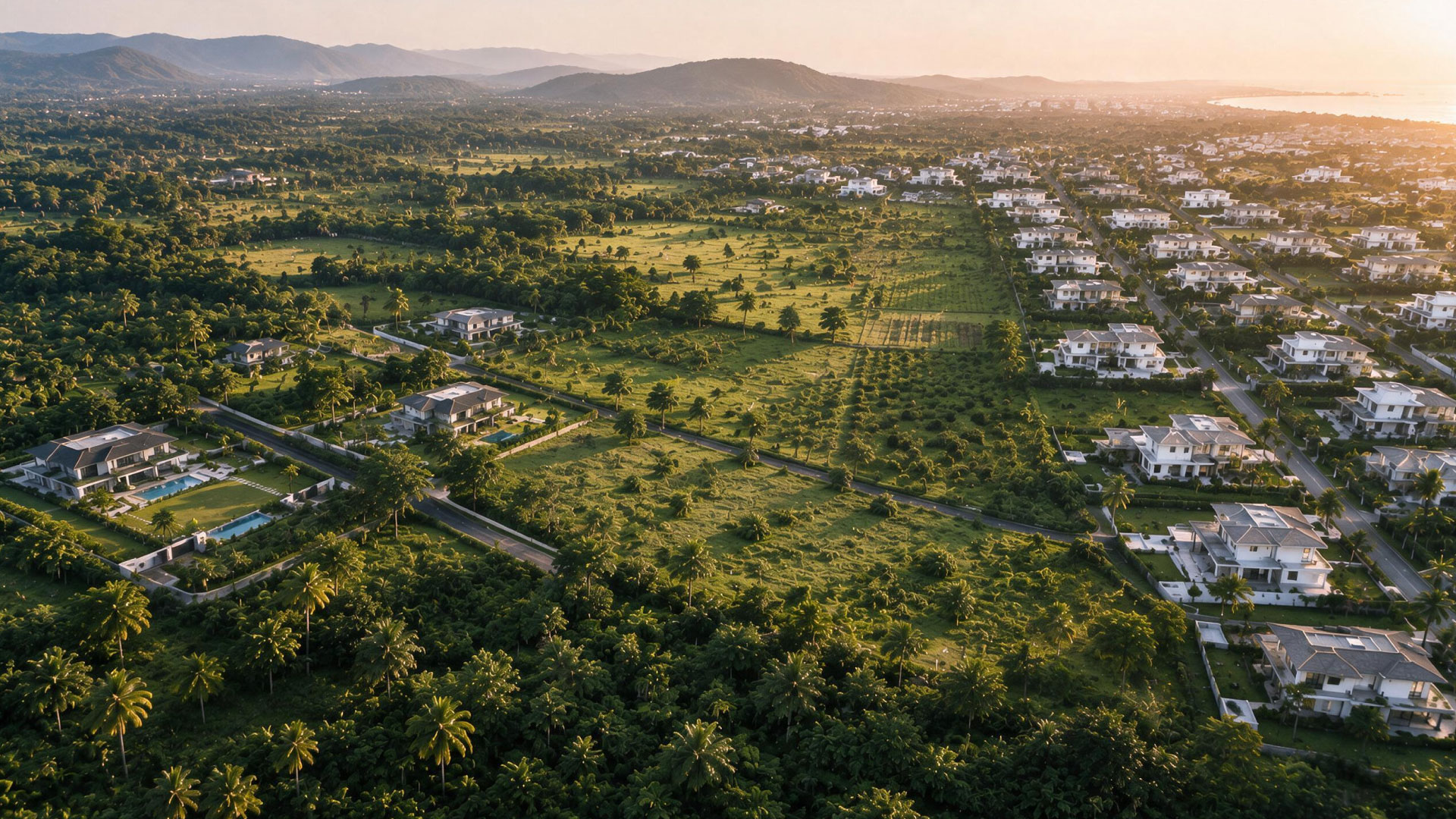
There is a number that sits at the centre of every serious conversation about Alibaug real estate, and it is not a CAGR figure or a rental yield. It is 4.8%. That is the percentage of land across the Alibaug region that is legally available for residential development. The rest falls under the Coastal Regulation Zone, the No Development Zone, agricultural classifications, or forest and wetland designations that no amount of demand can dissolve.
Understanding what 4.8% means in practice requires understanding what the other 95.2% cannot become. A buyer who arrives in Alibaug and looks at the open landscape, the coconut groves and paddy fields and mangrove edges, and assumes that this space represents latent supply available to future developers is misreading the map. The CRZ framework, administered by the Maharashtra Coastal Zone Management Authority, does not merely regulate coastal development.
The Infrastructure Argument Has Only One Direction
The second dimension is the infrastructure trajectory. Each connectivity improvement in this corridor has widened the addressable buyer pool without adding a single square metre of developable land to the supply side. The Atal Setu compressed the road journey from Mumbai to approximately 90 minutes. The Revas-Karanja Bridge, in its final stages, will bring that to around 60. The Navi Mumbai International Airport is now operational at Ulwe. And the proposed Panvel to Alibaug rail corridor, part of the Virar-Alibaug Multimodal Corridor, would make the coast reachable without a car for the first time, turning this from a weekend proposition into something closer to a commutable address.
Each of these projects increases the number of people for whom Alibaug is a realistic choice. None of them increases the land available for those people to buy. That asymmetry is not an incidental feature of this market. It is the feature.
What the Appreciation Numbers Actually Reflect
The historical pattern that follows from this kind of supply constraint is well established. The coastal strip between Mandwa and Sasawane has delivered capital appreciation of 10 to 12% compounded annually, alongside rental yields of 5 to 7% for well-managed coastal villas. These are the results of a market where demand has been expanding, infrastructure has been improving, and the developable land area has remained fixed. India’s ultra-high-net-worth individuals identified this arithmetic early, allocated accordingly, and are now established here. The cluster they created has itself become a draw, raising the floor on values in a way that broad market cycles cannot easily erode.
The buyer still waiting faces a different version of the same calculus. The infrastructure improvements already delivered have been partially priced in. The ones still in progress have not yet been fully reflected. That gap between announced and operational infrastructure is historically the window in which the strongest entry positions are taken.
The Inventory Reality No Brochure Mentions
There is also the inventory question. Within the 4.8% of developable land, the supply of genuinely well-positioned, legally clean, architect-designed coastal villas in the right part of the coastal belt is very small. When the combination of CRZ clearance, a valid NA Order, full RERA compliance, IGBC certification, jetty proximity, and design by a name with an international record exists in a project of only six units, the effective inventory available to the right buyer at any given moment is a single-digit number.
Waiting in a supply-elastic market carries a different set of risks from waiting in a market where the supply side is both small and fixed. In the latter, the cost of waiting is not merely opportunity cost measured in appreciation foregone. It is the risk of the specific asset you were considering no longer being available when you decide.
The Documentation Layer That Makes Scarcity Count
The legal compliance layer that underlies the right coastal purchase carries its own weight alongside the scarcity argument. An NA Order, a valid CRZ clearance, a full title chain, and both a Completion Certificate and an Occupancy Certificate are the documents that convert a scenic address into a clean, bankable, resaleable asset. A property missing any part of this documentation does not benefit from scarcity the way a clean asset does. The full compliance stack that serious Alibaug buyers verify is the difference between owning a position in a constrained market and owning a liability with a sea view.
The Sands by Aroha Estates
The Sands by Aroha Estates is a collection of six boutique villas designed by architect Sanjay Puri, IGBC Green certified, 500 metres from Sasawane Beach and nine minutes from the Mandwa Jetty. Eighty percent of the land is held as open space. Each villa carries a private pool, glass facades sized for light and the Arabian Sea beyond, and the full documentation stack that a market this constrained, and this mature, demands. The project sits on the right side of the 4.8%, in the right part of the coastal belt, at a moment when the infrastructure tailwinds are still building.
The question the scarcity argument poses to anyone still deliberating is a direct one. The land does not expand. The infrastructure continues to improve. The cohort of buyers continues to grow. The inventory of genuinely clean, well-positioned coastal villas does not replenish. Visit thesands.life or get in touch with the team.
FAQs
1. What makes only 4.8% of Alibaug’s land developable?
The Coastal Regulation Zone framework classifies coastal land by proximity to the High Tide Line and ecological sensitivity. CRZ-I prohibits most construction. CRZ-II and CRZ-III permit residential development under defined conditions. Added to these are No Development Zones, agricultural classifications, and forest or wetland designations. The 4.8% figure represents the aggregate of parcels that meet the conditions for residential development across the full region.
2. What is an NA Order and why does it matter in Alibaug?
An NA Order is the Revenue Department’s formal permission to use agricultural land for a non-agricultural purpose, including residential development. Most of the Konkan coast was historically classified as agricultural. Without a valid NA Order, land remains agricultural in law regardless of what stands on it, with direct consequences for loan eligibility, title registration, and resale. Verifying the NA Order is the foundational step in due diligence for any Alibaug purchase.
3. How do infrastructure improvements affect value in a supply-constrained coastal market?
Infrastructure increases demand by making the coast accessible to a wider buyer pool, without adding to the developable land supply. The result is upward pressure on values that compounds with each new project that becomes operational. In comparable Indian coastal markets, the strongest appreciation typically occurs in the window between infrastructure announcement and completion, not after it.
4. What documents constitute a fully compliant coastal villa purchase in Alibaug?
The essential stack includes a valid NA Order, CRZ clearance, RERA registration on the MahaRERA portal, a thirty-year title search, Commencement Certificate, sanctioned building plans, and both a Completion Certificate and Occupancy Certificate for a ready property. A property missing any of these does not offer the same legal security or resale position as one with a clean documentation record.
5. What does IGBC certification mean for a coastal villa buyer?
IGBC Green certification addresses construction materials, natural ventilation, water efficiency, and indoor environmental quality. In a coastal context, where salt-laden humidity and monsoon intensity place significant demands on building fabric, certification confirms the design has addressed those demands directly. It also aligns with the ESG thinking that serious buyers now apply to personal real estate decisions.