
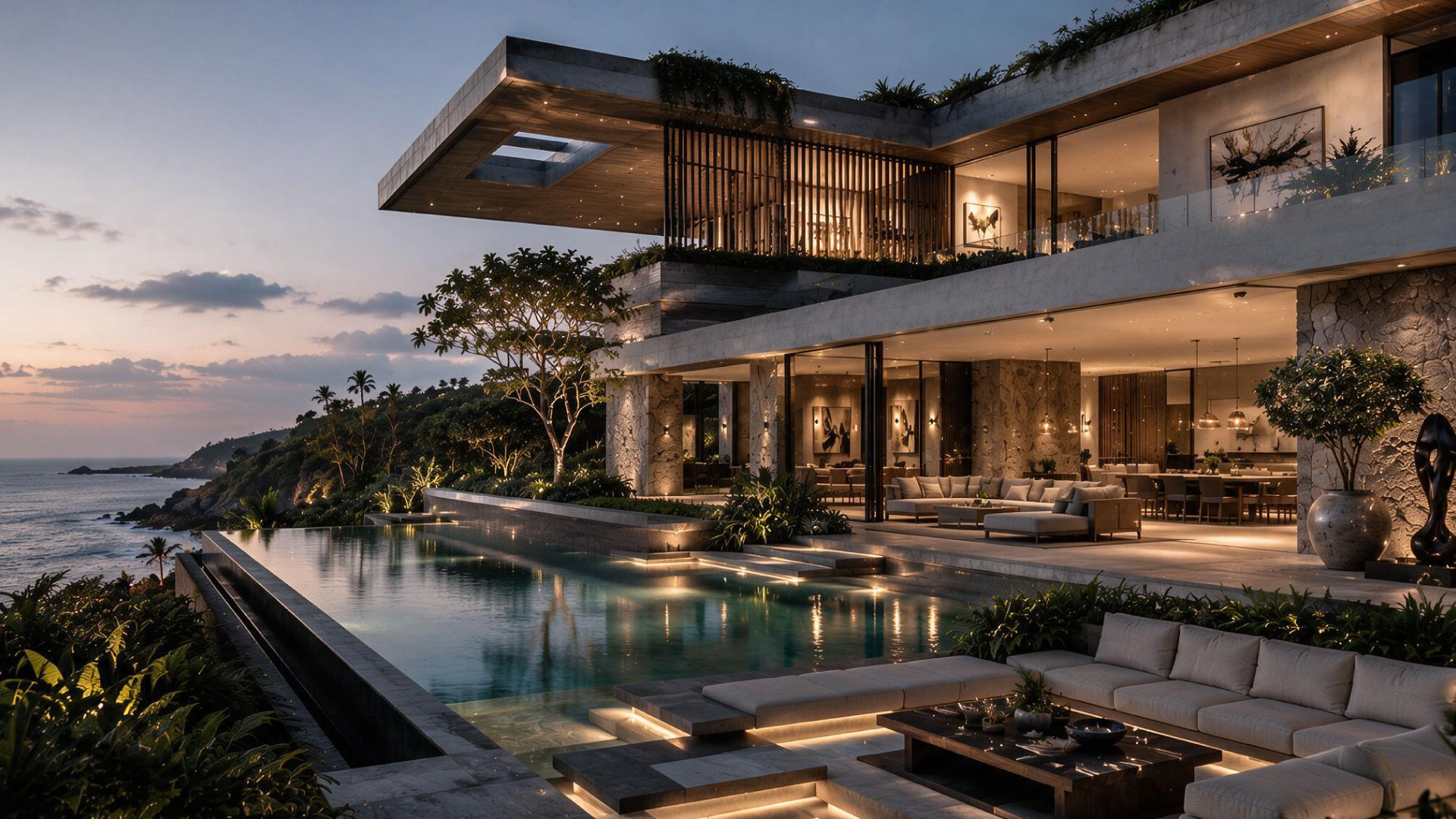
There is a particular quality to the light on the Konkan coast in the hour before the household wakes. It arrives low and salt-threaded off the Arabian Sea, laying itself across the stone floors of a well-designed villa the way light in a city apartment never quite manages. The air carries the smell of wet laterite and ocean. And somewhere in that stillness, before the day has negotiated its claims on you, a decision that was months in the making begins to feel obvious.
India’s wealthiest families are buying coastal villas in 2026 at a pace this market has not seen before. The reasons are layered, and they are not all about yield. The asset class has become, simultaneously, a financial argument and a life argument. And the Alibaug coast, for a growing number of these families, is where both converge.
The Non-Negotiable: Proximity That Actually Works
For a buyer whose time is the scarcest resource they manage, a coastal retreat is only as valuable as the ease with which it can be reached. A speedboat from the Gateway of India reaches Mandwa Jetty in 18 minutes. A helicopter takes 15. The road corridor via Atal Setu now brings drive times to roughly 90 minutes, and the Navi Mumbai International Airport provides an international entry point that bypasses the city entirely. The Revas–Karanja Bridge will compress road travel further. These are the kind of infrastructure shifts that transform a leisure destination into something people actually live in. The buyers moving now are not waiting to see what this corridor looks like three years from now.
Architecture With a Name Behind It
The wealthiest buyers are not purchasing a structure. They are purchasing a considered object, a home that reflects the same standards they apply to everything else they acquire. An internationally recognised architect, materials chosen for a coastal environment rather than merely applied to it: these are the baseline expectations of this cohort. IGBC Green certification has become a meaningful signal for the same reason. As we explored in our post on what IGBC certification means for an Alibaug villa, it indicates that the building was designed with the environment fully considered. ESG thinking has moved from boardrooms into personal portfolios. A certified villa speaks to values this buyer holds in both.
Scarcity as the Foundation of the Financial Argument
The investment logic for coastal Alibaug is unusually clean. Only approximately 4.8% of the land is developable, with the Coastal Regulation Zone and No Development Zone preserving everything around it. The result is a 10–12% CAGR over the past three years, alongside rental yields of 5–7% for well-positioned coastal villas. The wealthiest buyers are arriving not because of a yield calculation alone, but because the coastal strip around Mandwa and Sasawane appreciates at a rate the interior cannot match. And as the Budget 2026 environment held tax structures steady and delivered infrastructure capital expenditure at scale, buyers have the one thing a significant real estate allocation requires: predictability.
The Wellness Argument Has Become Impossible to Dismiss
Something has shifted in how India’s wealthiest families think about their second homes. The question is no longer purely financial. It is also physiological. Sustained coastal access produces measurable benefit: lower cortisol, better sleep, stronger respiratory health, and the kind of attentional recovery that no city environment replicates. We examined the science of coastal living in detail, and the evidence is not metaphor. For families managing lives of sustained complexity, a home where the air, the light, and the sound of the water are actively restorative is not a lifestyle argument. It is a performance argument.
The Year-Round Home, Not the Weekend Escape
India’s wealthiest buyers are no longer thinking about a coastal villa as somewhere they go between October and February. They are thinking about a property that earns the entire year. This means design that holds through the monsoon, architecture that is most compelling on a July afternoon with rain over the Arabian Sea, and management infrastructure that keeps the asset productive through every month the owner is elsewhere. Ownership that requires no effort when the owner is absent, and rewards every visit when they arrive: this is the standard now being applied.
The Neighbourhood as a Selection Criterion
There is a cluster effect on this coast that the wealthiest families understand without needing it explained. When the neighbourhood within a five-minute walk includes business leaders whose presence raises the floor on security and infrastructure, the address becomes self-reinforcing. As we have written about at length, the UHNI concentration in this corridor is both cause and consequence of everything that makes it valuable. Being early in a neighbourhood is the oldest capital allocation strategy there is.
The Sands by Aroha Estates
Against the requirements this cohort brings, The Sands by Aroha Estates is a project designed to answer every question a serious buyer asks. A private collection of six boutique villas designed by architect Sanjay Puri, IGBC Green certified, positioned 500 metres from Sasawane Beach and nine minutes from the Mandwa Jetty. Each villa comes with a private pool, expansive glazed facades, landscaped plantations at every level, and 80% of the estate kept as open space. A clubhouse with café and lounge, gym, spa, and pickleball court, all supported by 24/7 concierge services and professional rental management.
Visit thesands.life to explore the project, or reach out to the team to begin the conversation.
FAQs
1. What are India’s wealthiest families prioritising in a coastal villa purchase in 2026?
The priorities have converged around five things: proximity to the city that functions across a week rather than just a long weekend; architecture by a recognised name built for a coastal environment; full legal compliance across NA Order, CRZ clearance, and RERA registration; year-round usability supported by professional management; and a neighbourhood whose UHNI concentration provides a reliable floor on property values. The 10–12% CAGR and 5–7% rental yield are the frame. These five priorities are the substance.
2. How does IGBC Green certification affect resale value and long-term ownership?
IGBC certification signals that the construction met a standard of scrutiny most coastal villa projects do not reach: lower operating costs, better indoor environmental quality, and materials suited to salt-heavy coastal conditions. At resale, a certified property commands stronger interest from buyers making ESG-aligned decisions. The premium at acquisition tends to be recovered and exceeded across the asset’s lifetime.
3. What legal compliance should a buyer verify before committing to a coastal villa?
The essential stack covers the NA Order confirming non-agricultural use permission, the CRZ certificate for coastal zone classification, MahaRERA registration, a Commencement Certificate, sanctioned building plans, all statutory approvals, and both Completion Certificate and Occupancy Certificate for a ready property. A gap in any layer surfaces at the next transaction. An independent advocate conducting a thirty-year title search remains the most reliable due diligence at this scale.
4. Is Alibaug suitable as a primary base, or is it primarily a second home?
The distinction is becoming less meaningful for families with the flexibility to choose. Several UHNI families now operate from Alibaug as a primary base, travelling to Mumbai for meetings and returning the same day. IGBC-certified construction supports sustained daily living rather than just weekend visits, and infrastructure improvements underway will make the coast an increasingly commutable address.