
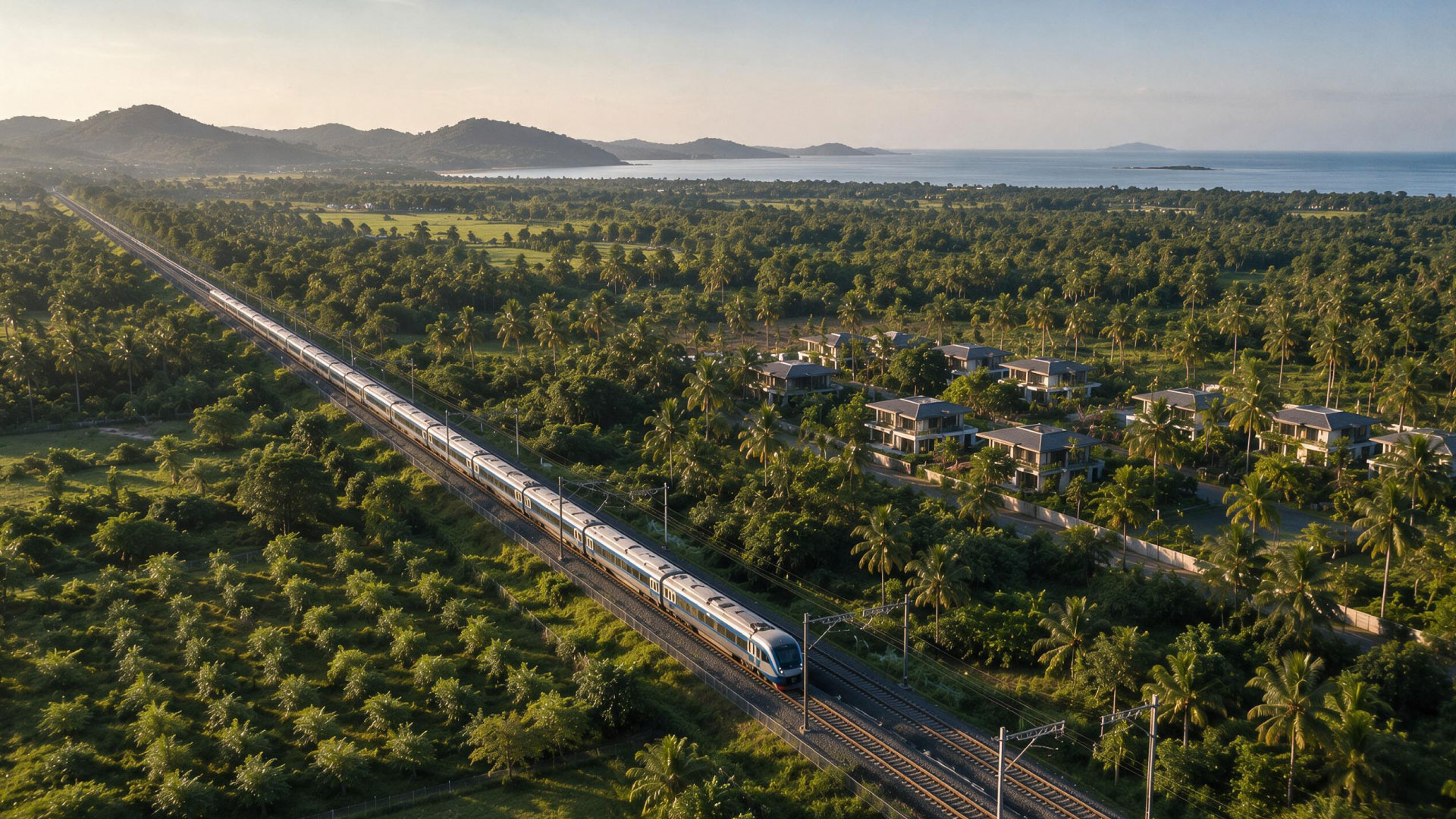
The map of Maharashtra has been redrawn in stages. First the Atal Setu, spanning Thane Creek with a scale that still surprises drivers who cross it in early morning light. Then the Revas-Karanja Bridge, closing the last gap across Dharamtar Creek and bringing the southern Konkan coast within an hour of Navi Mumbai. And now, on the drawing boards and in early project reports, a rail corridor from Panvel to Alibaug that would do something none of the road and water infrastructure could quite achieve: make this coast reachable without a car at all.
The corridor is proposed, and timelines carry their own uncertainty. But the logic behind the project is sound, and the direction of investment in this corridor has been consistent enough that the people who watch coastal real estate for a living have begun factoring it into conversations that would have seemed premature three years ago.
What the Connectivity Picture Already Looks Like
The existing connectivity picture is already stronger than most buyers realise. A speedboat from Gateway of India to Mandwa Jetty covers the crossing in 18 minutes. The RoRo ferry carries your car across in under an hour. The road via Atal Setu runs door to door in approximately 90 minutes, and the Revas-Karanja Bridge, in advanced stages of completion, is expected to compress that to around 60 minutes. For anyone wanting the full picture of how each route compares, the complete Mumbai to Alibaug travel guide for villa owners sets it out in detail.
What rail adds to this picture is not speed in the way a speedboat offers speed. It adds a different category of access: the kind that does not require planning, does not depend on sea conditions, and does not assume car ownership. A Panvel to Alibaug rail corridor, when operational, would allow a resident of Navi Mumbai, Thane, or any station on the existing suburban network to reach the coast the way people reach Lonavala from Pune: routinely, on a weekday evening if the inclination is there. That is not a weekend-escape proposition. That is a residential one.
The Investment Case Rail Infrastructure Writes
The investment case this coast already makes is built on scarcity. Only 4.8% of Alibaug’s land is developable under the Coastal Regulation Zone framework. Within that constraint, the coastal belt between Mandwa and Sasawane carries a demand profile the rural interior cannot match. The 10 to 12% CAGR the market has sustained, alongside rental yields of 5 to 7%, reflects land that does not become more available as the years pass. Every piece of infrastructure that reduces friction on the journey here compounds the underlying value rather than adding to the supply.
The Navi Mumbai International Airport, now operational, added an international entry point roughly 90 minutes from the coast. The Revas-Karanja Bridge narrowed the road journey further. The Virar-Alibaug Multimodal Corridor, of which the Panvel rail link forms a component, is designed to thread the entire coastal belt into the metropolitan rail network in a way no single bridge or road can accomplish. Taken as a sequence, these are not independent projects. They are a compounding argument for a coast whose time has not yet fully arrived.
India’s ultra-high-net-worth individuals have made Alibaug one of their primary real estate destinations in 2026, not as an afterthought to a primary holding, but as a deliberate capital allocation in a supply-constrained market. That cohort moved early. The infrastructure developments now unfolding are the second-mover argument: the thesis has been validated by the people who validate things first, and the entry window, while still open, is narrower than it was when the Atal Setu was still a proposal.
What Rail Actually Changes for This Coast
Rail changes the nature of a location in ways road infrastructure does not. Roads widen access but keep the journey effortful in the sense that someone must drive, park, and navigate. Rail removes that friction entirely. When a station exists, the coast becomes a place you go the way you go to any neighbourhood served by a network: because you can, without much deliberation. The rental implications are worth considering separately: a villa within reach of a rail terminus is a different product for a guest arriving from a city station without a vehicle, opening the market along an axis that current connectivity does not.
The Documentation That Makes Infrastructure Count
The legal compliance picture that underlies any serious coastal investment is worth holding alongside the infrastructure story. An NA Order, a valid CRZ clearance, full RERA registration, and a clean title chain are the conditions under which appreciating infrastructure translates into appreciating asset value. A plot that looks well-positioned for a rail corridor but carries documentation gaps will not benefit the way a clean asset would. Understanding NA Orders and what full legal compliance requires is the starting point for any buyer who takes the long-term thesis seriously. Legal clarity and infrastructure tailwinds compound together, or they do not compound at all.
The Sands by Aroha Estates
The Sands by Aroha Estates occupies the position in this market that the infrastructure argument points toward. Six boutique villas designed by architect Sanjay Puri, IGBC Green certified, 500 metres from Sasawane Beach and nine minutes from the Mandwa Jetty. Private pools, wide glass facades, 80% of the land as open space, a clubhouse with 24/7 concierge. Fully documented: NA Order, CRZ clearance, RERA registration, Completion Certificate, Occupancy Certificate. The kind of asset that benefits from every piece of infrastructure that arrives, because it was built with the intention of lasting for all of it.
If the Panvel to Alibaug rail corridor does what rail corridors have consistently done to the coastal land they serve, the people who own clean, well-positioned assets here before it opens will look back at this window the way early Bandra buyers look back at theirs. If interested get in touch with the team.
FAQs
1. What is the Panvel to Alibaug rail corridor?
The Panvel to Alibaug rail corridor is a proposed link forming part of the broader Virar-Alibaug Multimodal Corridor. It would connect Panvel, a major node on the existing suburban rail network, directly to the coast, making the journey possible without a car. Timelines carry inherent uncertainty, but the project is in the planning and approvals phase alongside the other infrastructure investments in this region.
2. How does rail connectivity differ from road and water connectivity for property values?
Road and water infrastructure reduce journey time. Rail changes the nature of access itself, allowing residents of Navi Mumbai or any connected suburban station to reach the coast without a car, routinely, the way one commutes to any rail-served neighbourhood. That expands who can realistically use a coastal villa, and opens the rental market to guests arriving without a vehicle.
3. Does the proposed rail corridor affect the investment case for buying now?
Yes. Evidence from comparable corridors consistently shows that values accelerate during the announcement and construction phase rather than after opening. Buying clean, well-documented coastal land before a rail corridor is operational is historically the position that produces the strongest returns.
4. What other infrastructure projects are improving Alibaug connectivity?
The full picture includes the Atal Setu, the Revas-Karanja Bridge reducing road travel to approximately 60 minutes, the Navi Mumbai International Airport now operational at Ulwe, and the RoRo ferry between Mumbai and Mandwa. Together these represent a consistent, layered investment in the Mumbai-Alibaug corridor.
5. What legal documents should a buyer verify before purchasing a coastal villa in Alibaug?
The essential checklist includes the NA Order confirming non-agricultural land conversion, a CRZ clearance, RERA registration on the MahaRERA portal, a thirty-year title search, the Commencement Certificate, sanctioned building plans, and both the Completion Certificate and Occupancy Certificate for a ready property. Infrastructure tailwinds benefit only assets whose documentation is clean from the ground up.