
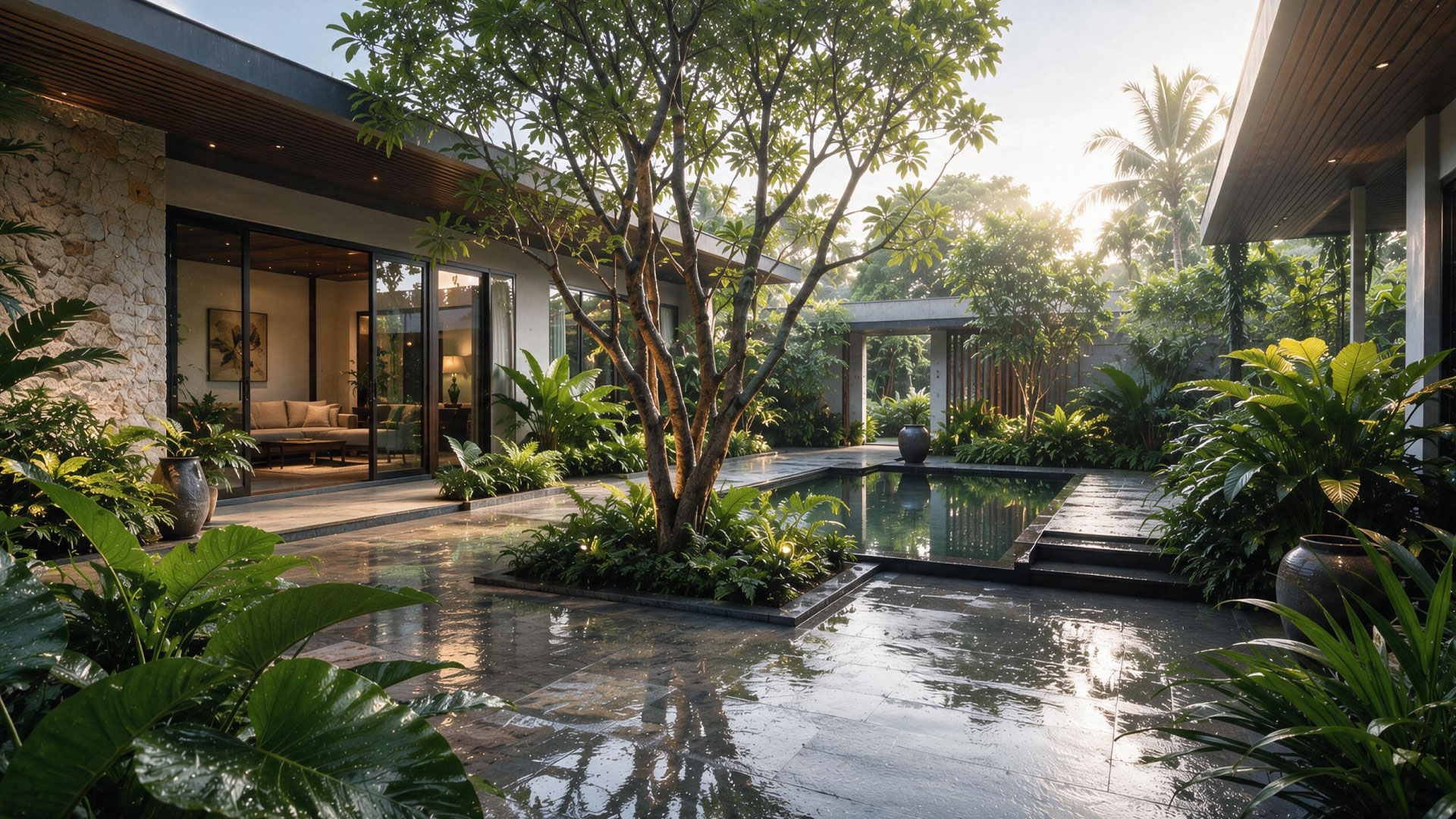
The rains hit their stride in August. Not the tentative first showers of June, carrying the season’s novelty, nor the relentless curtain of a particularly angry July. August in Alibaug has a different character: purposeful, immersive, and, for the few hundred people who own a home on this coast, quietly extraordinary.
There is a version of the monsoon that belongs to the city. Waterlogged roads, cancelled trains, the particular exhaustion of a commute conducted inside a traffic jam while the sky empties itself onto everything. And then there is the version that belongs to people watching it from a glass-walled living room 500 metres from the Arabian Sea, with a private pool catching the rain in long silver threads and the sound of the Konkan evening arriving on schedule.
What August Does to This Coast
The Konkan landscape reaches its most saturated state in August. The green that begins in June, the tentative, almost polite green of a season just finding its register, has by now become something aggressive and luminous. The hills behind Sasawane Beach hold a depth of colour that photographers make specific trips to find. Banana plantations line the road from Mandwa toward the beach, their leaves heavy and glistening. The laterite earth turns a vivid rust.
The Arabian Sea is doing something entirely different from its winter self. The horizon disappears into low cloud. The waves work with an intensity that the summer tourist season never witnesses. The sea at Sasawane in August is not the sea for swimming. It is the sea for watching, from a covered deck with something warm in hand, as it conducts its business without any audience in mind.
This absence of audience is, in itself, one of August’s pleasures. The crowds that fill the coastal circuit from October through February have retreated entirely. The coast belongs to its owners and a handful of guests who understand what the season actually offers. It is the closest Alibaug comes to its pre-discovery self.
The Logic of Staying In
Coastal living carries measurable restorative effects on the nervous system, and August delivers those effects in concentrated form. The sound of rain on a terrace is, in acoustic terms, a form of pink noise, linked to improved sleep quality and reduced cortisol. Add the salt-laden coastal air, cleaner by measurable degrees than the urban air most owners breathe during the working week, and the body registers the arrival at the villa before the mind has finished catching up.
The interior of a well-designed coastal home earns its keep in August in a way no other season tests. Wide glass facades open to the monsoon landscape. Covered gazebos hold the outdoor quality of the space while the rain falls three feet away. A private pool catches the storm in rain-dimpled silver and reflects a sky doing something extraordinary. The IGBC-certified construction at The Sands addresses natural ventilation and indoor environmental quality directly, which is to say the home breathes well precisely when the outside is at its most dramatic.
August evenings follow a rhythm that city weeknights cannot produce. The 5 pm masala chai is non-negotiable in this season, a Konkan ritual that predates any cafe culture. Dinner is long and unhurried. Conversations stretch. The evening culture that villa owners have built here around private dinners, a particular togetherness that only emerges when the agenda has been cleared by the weather, reaches its most natural expression in the peak monsoon months.
Getting Here Is Not the Problem People Assume
The standard objection to an August visit is connectivity. The ferry from Gateway of India to Mandwa Jetty is subject to sea conditions and during the monsoon weeks, suspensions are common. This is a logistical fact, not a deterrent.
The road via Atal Setu runs in all weather, bringing the drive from Mumbai to approximately 90 minutes door to door. The Revas-Karanja Bridge, when complete, will compress that further. For villa owners who have structured their weeks around a hybrid rhythm, the coast is never inaccessible. The drive into Konkan in August, past rice paddies filling with water and fields turning a colour that has no adequate name in English, is its own argument for the journey.
August Has a Food Logic All Its Own
The food scene on this coast has matured into something genuinely surprising, and August gives it a particular register. The Malvani kitchen is built for this weather. Sun-dried fish rehydrated into gravies with fresh coconut milk. Freshwater prawn curries that carry the season’s abundance. The hand-pounded masalas of the Konkan coast have a warmth and depth that August afternoons call for in a way no summer menu can approximate.
The restaurants that matter here remain open through the monsoon. An August evening that begins with a drive through rain-soaked laterite country and ends at a candlelit outdoor courtyard in a gap between the showers is the kind of evening that outlasts the season in memory.
The Property Argument, Made Quietly
August is when the ownership logic reveals itself most clearly, separate from any yield spreadsheet. A property meaningful only in good weather is not meaningfully owned. A home that earns its keep across all twelve months, including the four that most coastal developments prefer to ignore, is a different category of asset.
Only 4.8% of Alibaug’s land is developable, and within that constraint the coastal belt carries a demand profile the rural interior cannot match. The 10 to 12% CAGR, the 5 to 7% rental yields, the UHNWI cohort that has made this coast one of its primary allocations in 2026 all rest on a foundation that is visible in August precisely because August strips the scenery away and leaves the structure standing.
The Sands by Aroha Estates
The Sands by Aroha Estates was built for the full year. Six boutique villas designed by architect Sanjay Puri, IGBC Green certified, 500 metres from Sasawane Beach and nine minutes from the Mandwa Jetty. Private pools, glass facades sized for light and monsoon views, covered terraces, plantation gardens across 80% open land. A clubhouse, spa, gym, and 24/7 concierge available through every season, including the four months when the Arabian Sea reminds you why you chose to live beside it.
August is when The Sands makes its most honest case. Visit thesands.life or get in touch with the team.
FAQs
1. Is August a good time to visit Alibaug if you own a villa?
August is one of the most immersive months to be at your Alibaug villa. The landscape is at its most dramatically green, the coast is uncrowded, and the quality of indoor living, private pool, covered deck, and a monsoon viewed from a well-designed home, is unlike any other season.
2. Can I reach Alibaug by road if the ferry is suspended during August?
Yes. The Atal Setu and the road corridor through Navi Mumbai provide a weather-independent route of approximately 90 minutes from the city. Ferry suspensions during peak monsoon are common and planned around; road access remains unaffected.
3. Is swimming safe in Alibaug during August?
Open sea swimming at most beaches is not advisable through July and August when the Arabian Sea is rough. The private pool is the water experience the season is built around.
4. Do restaurants and local establishments stay open through peak monsoon?
Yes. The town functions normally through the monsoon. Cafes, restaurants, and local markets remain operational. Some beachside shacks reduce hours during heavy rain, but established dining spots and private chef arrangements through your estate concierge are available year-round.
5. How does the monsoon affect the investment value of an Alibaug coastal villa?
It does not diminish it. A well-built villa on a legally clear coastal plot continues to appreciate through the monsoon months alongside the broader 10 to 12% CAGR trend this market has sustained. Rental demand from guests who specifically seek the monsoon experience means yields remain active across the year rather than concentrated in the winter season alone.