
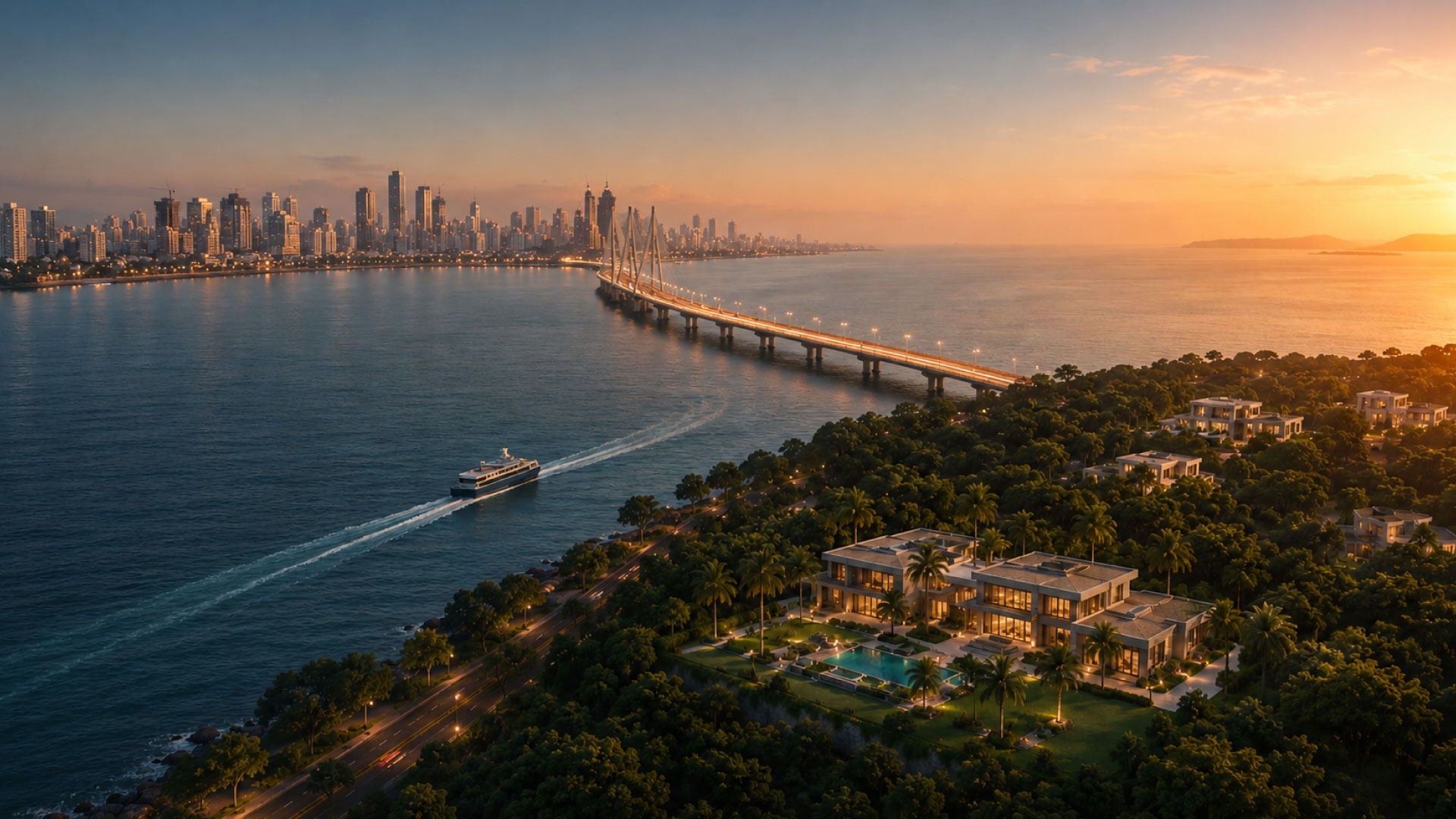
There is a particular quality to the morning light at Sasawane Beach salt-threaded, low, arriving off the water before the coconut palms have decided which direction they are leaning. It is the kind of light that makes property decisions feel obvious, that strips away the spreadsheets and the yield calculations and leaves behind something simpler: the understanding that this coast is genuinely rare, and that the people who have understood this longest have been arriving for years already.
What has changed in 2026 is not the coast itself. What has changed is the breadth and seriousness of the cohort arriving on it. India’s ultra-high-net-worth individuals the business families, the founders, the industrialists who move between cities the way other people move between rooms have made Alibaug one of their primary real estate destinations. Not as a weekend afterthought. As a considered, deliberate allocation of capital and life.
The Scarcity Argument
The short answer to why ultra-high-net-worth individuals buyers are here is scarcity. Only approximately 4.8% of Alibaug’s land is developable, with the rest falling under the Coastal Regulation Zone and No Development Zone. When land is this constrained and appetite is not, the mathematics of appreciation become unusually reliable.
The result is a 10–12% CAGR over the past three years, alongside rental yields of 5–7% for well-positioned coastal villas. These numbers speak to wealth managers. But the buyers arriving are not only following a yield thesis. They are following each other.
There is a cluster effect on this coast that becomes self-reinforcing. When the neighbourhood includes business leaders, Bollywood names, and entrepreneurs who prize privacy over profile, the social infrastructure rises to meet them. A five-minute walk from the right address in Alibaug takes you past some of India’s most recognised names. That is not coincidence. It is the compounding logic of a place where the right people chose to be early.
The Connectivity Argument Has Become Unanswerable
A speedboat from the Gateway of India to Mandwa Jetty takes 18 minutes. A helicopter takes 15. The Atal Setu and the road corridor via Navi Mumbai have brought road travel to roughly 90 minutes. The Navi Mumbai International Airport, now operational, sits approximately 90 minutes from the coast, adding an international entry point that bypasses the city entirely.
The Revas–Karanja Bridge is expected to reduce road travel further, to around 60 minutes. Infrastructure investment in this corridor has been consistent and layered. For UHNI buyers who weigh a second home partly on the frictionlessness of the journey, the Alibaug proposition now answers every objection. The coast is no longer visited on long weekends. It is inhabited through hybrid weeks, extended holidays, and the months when the instinct is to be somewhere quieter and more one’s own.
What This Cohort Is Actually Looking For
The UHNI villa buyer is not looking for a holiday home in any conventional sense. They want an asset that holds its value with conviction, a space that functions as beautifully as it appreciates, and a location that signals discernment. Architecture by a name with an international record matters to this buyer. So does IGBC Green certification ESG thinking has moved from boardrooms into personal portfolios, and a villa certified for sustainable construction speaks to values this buyer holds in both professional and private life.
They also want management without friction the ability to lock the door in Mumbai and have the property maintained, rentable, and returned to exactly as they left it. And the post-Budget 2026 environment, which held tax structures steady and delivered infrastructure capital expenditure at scale, has given buyers the one thing a significant real estate allocation truly requires: predictability.
Why Location Within Alibaug Determines Everything
The coastal belt Mandwa, Awas, and the stretch approaching Sasawane Beach carries a fundamentally different demand profile from the rural interior. Proximity to the Mandwa Jetty is the primary variable. It is the difference between a property used freely on a Tuesday evening and one that requires a planned expedition. The coastal strip appreciates at a rate the inland parcels cannot match, driven by UHNI concentration, inventory scarcity, and the irreplicability of the location itself.
The Sands by Aroha Estates
Against this backdrop, The Sands by Aroha Estates occupies a position that is genuinely difficult to replicate. A private collection of six boutique villas designed by architect Sanjay Puri whose work has received over 450 global accolades and certified by the Indian Green Building Council, this is a project conceived for buyers who understand that the difference between a property and a home is not square footage. It is intention.
The villas sit 500 metres from Sasawane Beach, a nine-minute drive from the Mandwa Jetty, in a neighbourhood where notable figures have quietly put down roots for years. Each unit comes with a private pool, expansive glazed facades, landscaped plantations at every level, and 80% of the estate kept as open space. A clubhouse with café and lounge, gym, spa, and pickleball court rounds out the amenities all supported by 24/7 concierge services and professional rental management.
For the UHNI buyer in 2026, this is the conjunction of everything the market is asking for: genuine scarcity, impeccable positioning, internationally recognised architecture, certification that aligns with how serious buyers now think, and an ownership structure that is pleasurable rather than effortful. Visit thesands.life to explore the project, or get in touch with the team.
FAQs
1. What distinguishes Alibaug from other Indian coastal markets for UHNI buyers?
The combination is unusual: 18 minutes by speedboat from the Gateway of India, and a regulatory framework that keeps developable land at just 4.8% of the total. That twin quality radical proximity to the country’s financial capital and genuine scarcity on the ground is what UHNI buyers consistently find unavailable elsewhere. Goa is a flight. Lonavala has no sea. Alibaug has both the water and the weekend.
2. How does UHNI concentration affect values for new buyers?
The cluster effect in luxury real estate is well-documented. When ultra-high-net-worth residents reach critical mass in a location, the floor on property values stabilises in a way broader market cycles cannot easily erode. In Alibaug’s coastal belt, that cluster has been building for over a decade, with the practical consequences of better local infrastructure, more serious services, and a social environment that serious buyers actively seek when they buy.
3. Is Alibaug suitable for full-time residence, or primarily a second home?
The distinction is becoming less meaningful for those with the flexibility to choose. Several families now operate from Alibaug as a primary base, travelling to Mumbai for meetings and returning the same day. Hybrid work has made this comfortable. And IGBC-certified construction proper ventilation, energy systems, indoor environmental quality means the home supports sustained daily living, not just weekend visits.
4. How should a UHNI buyer think about rental income from an Alibaug villa?
The 5–7% rental yield is the more conservative part of the equation. The more useful frame is total return: that yield alongside 10–12% CAGR in capital growth produces a compounding case that holds up to serious scrutiny. A well-managed villa in the coastal belt, listed through premium platforms and supported by professional concierge services, can cover a significant portion of annual carrying costs while the underlying land continues its appreciation. The asset pays towards itself while you decide when next to use it.