
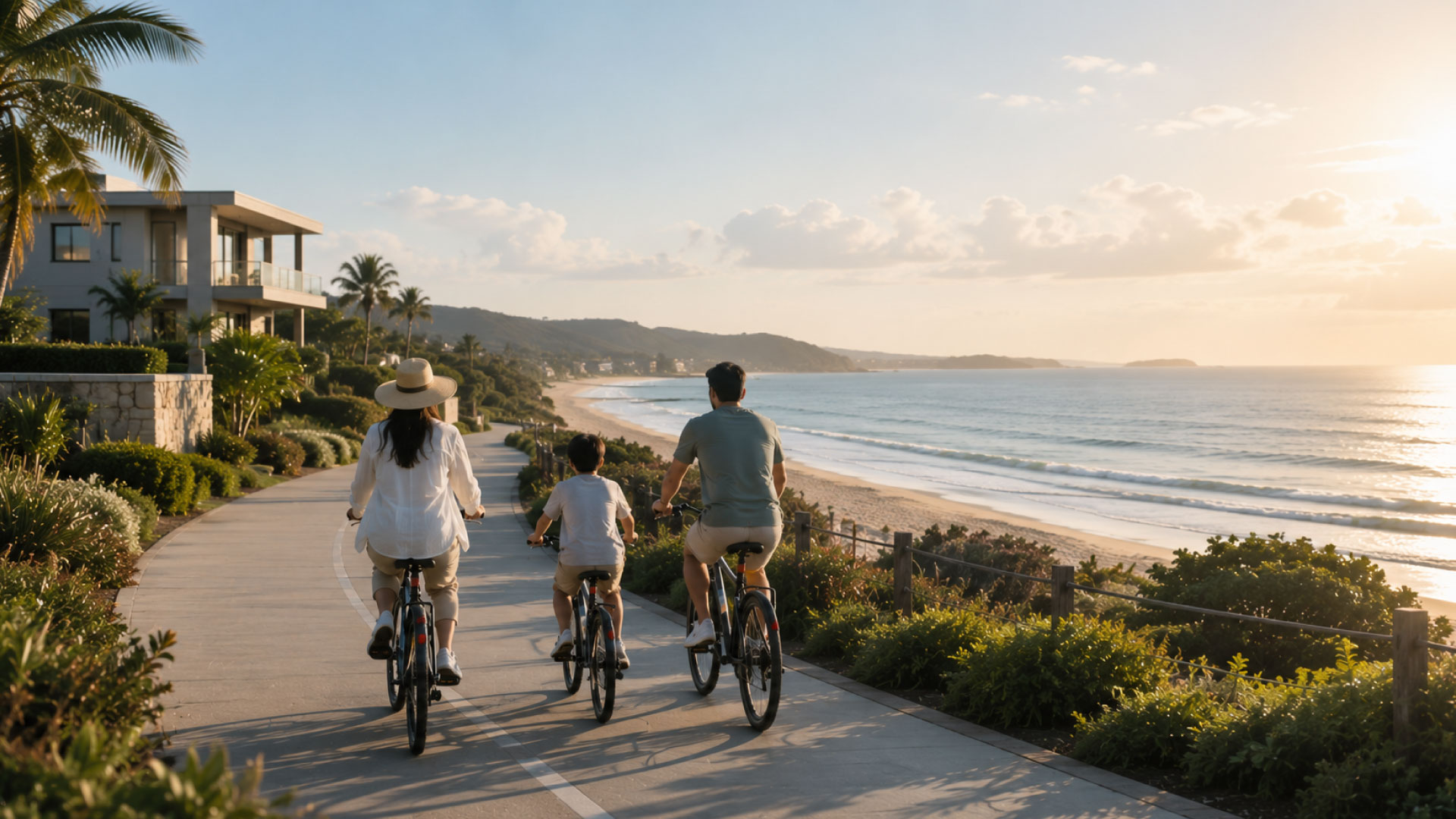
There is something that happens to the body within minutes of arriving on a coast. The shoulders drop. The breath deepens. The particular grip that the week has on the mind the unread messages, the commute, the low hum of obligation begins to loosen before you have taken off your shoes. Most people call it relaxation. Neuroscience has a more precise vocabulary for it.
The relationship between the sea and human wellbeing is not metaphor. It is measurable, documented, and increasingly studied across environmental psychology, neurology, and public health. What you feel standing on the edge of the Arabian Sea at Sasawane Beach at six in the morning that sense of the mind going still is not imagination. It is your nervous system responding to one of the most restorative environments it has ever encountered.
The Blue Mind: What Water Does to the Brain
The term blue space entered the scientific literature to describe aquatic environments coastal shorelines, rivers, lakes and their demonstrable effects on human psychological health. A landmark European study, the BlueHealth initiative, analysed data from over 25,000 participants across 18 countries and found that people living within one kilometre of the coast reported significantly better mental health and life satisfaction than those who did not. The effect held independent of income, education, or physical activity levels. The proximity itself was doing something.
Moving water produces negative air ions oxygen atoms carrying an extra electron, generated by the friction of water meeting air and clinical research has linked them to increased serotonin production, the neurotransmitter most closely associated with mood stability and calm. The sea is, in a very literal sense, delivering a neurochemical response that urban environments almost never replicate.
There is also the visual dimension. In any direction inland, the eye encounters edges buildings, treelines, the back wall of a room. On the coast, the eye reaches the horizon and finds nothing, which neurologically registers as absence of threat. The brain’s threat-detection circuitry, running at low volume in dense environments, quiets. Cortisol levels drop measurably in blue space environments, sometimes within twenty minutes.
The Air, the Sleep, the Quiet Recovery
Coastal air carries a particular composition. Salt aerosol particles from wave action are anti-microbial and have long been associated with respiratory health benefits which is why coastal locations were once prescribed for lung conditions by physicians, a practice that preceded the science that would eventually validate it. Coastal air also has significantly lower concentrations of the particulates, VOCs, and nitrogen dioxide that characterize urban air. In Mumbai, particulate matter in dense residential areas can run at several multiples of what the Alibaug coast delivers on a clear morning.
Studies tracking longitudinal health outcomes for populations with regular coastal access have found lower incidences of respiratory illness, lower rates of obesity, and better cardiovascular markers. The decision to invest in a luxury villa in Alibaug is also, in the most direct sense, a decision about the air your lungs will process in the first hours of every day you spend there.
Sleep, too, tends to be different at the coast. The rhythmic, non-patterned sound of waves sometimes called pink noise in acoustic research actively supports sleep quality by masking the irregular sounds of urban environments that cause micro-arousals throughout the night. Natural light exposure at the coast, unfiltered by urban haze, synchronizes melatonin production and circadian rhythms. A morning walk on Sasawane Beach delivers a level of light stimulus city environments almost never match, and that signal cascades into better sleep the same night.
Sustained Access, Not a Weekend Visit
Attention Restoration Theory, developed by environmental psychologists Rachel and Stephen Kaplan, proposes that natural environments possess a quality they termed fascination a kind of effortless attention that the brain extends to nature without the directed cognitive effort of work or urban navigation. Coastal environments allow the directed attention systems of the prefrontal cortex to recover from fatigue, producing better sustained attention and lower reported mental exhaustion. The coast is not just pleasant. It is neurologically restorative in ways that city parks do not fully replicate.
This is one of the reasons experiencing Alibaug as a villa owner is fundamentally different from visiting for a weekend. Sustained, regular coastal access produces cumulative neurological benefit. A weekend, however restorative, returns you to the city before the deeper recovery has had time to compound.
The Environment You Live In
The restorative power of the coast is inseparable from its environmental integrity. The quality of the sea air, the cleanliness of the horizon these are not guaranteed by geography alone. They are the product of how the buildings that surround them are designed and built. This is one reason why IGBC certification matters beyond the investment logic. A building that addresses indoor air quality, natural ventilation, and water management actively extends the restorative quality of the coastal environment into the interior of the home. Sustainable construction on the coast is not a premium feature. It is what the coast, and your health, actually deserve.
The Sands
Five hundred metres from Sasawane Beach, nine minutes from the Mandwa Jetty, in a neighbourhood where some of India’s most recognized names have quietly put down roots. The Sands by Aroha Estates is a private collection of six boutique villas designed by architect Sanjay Puri and certified by the Indian Green Building Council. The villas are built to bring the sea inside glass facades, open decks, private pools, 80 percent of the land kept as open space. The architecture is built around light and air, both of which arrive off the Arabian Sea every morning without ceremony.
The science is clear about what extended coastal access does to the human body and mind. The question it does not answer for you is where, specifically, that access will be. Explore The Sands at thesands.life or get in touch with the team here.
FAQs
1. Is there scientific evidence that living near the sea is better for mental health?
Yes, and the evidence base is substantial. The BlueHealth initiative found consistently better self-reported mental health and life satisfaction among coastal residents across 18 countries. Independent research in the UK, Australia, and the Netherlands has replicated the finding: proximity to blue space produces measurable psychological benefit, independent of socioeconomic variables or physical activity levels.
2. What makes coastal air different from city air?
Coastal air carries salt aerosol particles, negative ions from wave action, and far lower concentrations of urban pollutants than city air. The difference between the Alibaug coast and central Mumbai is not marginal. The connectivity improvements underway between the two mean the coast is increasingly within reach for extended stays long enough for those cumulative health benefits to compound.
3. Does green building certification like IGBC have any direct benefit for residents’ health?
It does. IGBC assessment criteria include indoor environmental quality ventilation rates, natural light levels, and the use of non-toxic materials. In a coastal context, where the logic is to bring the outdoors in, a green-certified building engineers its interior to support that aspiration. Lower VOC levels, better air circulation, and natural light strategies all contribute to the quality of the environment where you will spend significant parts of your time.
4. Is Alibaug a practical coastal base for someone who still needs to be in Mumbai regularly?
Increasingly, yes. An 18-minute speedboat from Gateway of India to Mandwa Jetty, followed by a nine-minute drive, puts you at the coast faster than many Mumbai residents can cross the city at peak hours. The Ro-Ro ferry carries your car across in under an hour, and the Atal Setu has reduced road travel to roughly 90 minutes. The infrastructure improvements still in progress the Revas–Karanja Bridge, the Navi Mumbai International Airport will compress that further. The coast is no longer a retreat you budget a weekend for. For villa owners, it is a commutable address.